
🪡 Untangling Culture from Religion: What Islam Really Says About Marital Harmony
It is an unspoken tension that often settles into the quiet corners of a home. You look across the room at your husband and feel a subtle, growing distance—a sense of emotional disconnection that leaves you feeling lonely, even when sitting side by side. Perhaps conversations have turned into brief, administrative exchanges about household chores or schedules, and the warmth that once defined your union feels like a distant memory.
In those heavy moments, a familiar, cultural whisper often creeps in.
Maybe you have heard well-meaning advice suggesting that marriage is simply about enduring hardships silently, or that if you just practiced more outward patience (صَبْر), the emotional gap would fix itself. The underlying, unspoken cultural message is deeply exhausting: a struggling marriage is simply a woman’s burden to bear, and seeking more for your relationship means you are ungrateful.
But here, I might offer you the liberating truth you need to hear today:
“A thriving, emotionally fulfilling marriage is a divine right, and building it requires intentional, practical psychological tools alongside your faith!”
Your desire for deep connection, genuine intimacy, and emotional safety is entirely valid. Experiencing marital drift does not mean your union is doomed, nor does analyzing your relationship through a psychological lens mean you lack trust in Allah ﷻ. In fact, nurturing the bond between husband and wife is deeply rooted in the holistic traditions of Islamic psychology, where the Nafs (نَفْس), the Qalb (قَلْب), and the Ruh (رُوح) are beautifully intertwined.
By combining the latest, evidence-based relationship science with timeless spiritual wisdom, we can look at marriage not as a source of silent endurance, but as a sanctuary of Sakinah (سكينة)—true inner peace and emotional tranquility.
🧶 The Root of the Bond: Distinguishing True Companionship from Cultural Endurance
In my consulting work, I frequently observe that many Muslim couples struggle not because they lack love, but because they have never been given a clear framework for how to build a lasting relationship. Culturally, we are often taught that marriage is a static contract—something that simply stays intact by default unless a major crisis occurs.
When you are told to overlook a total absence of emotional intimacy because your partner “provides for the household,” you are experiencing a cultural minimization of marriage, not an Islamic one.
In reality, Islam frames marriage as a dynamic, living entity that must be actively nourished. The Quran beautifully describes this bond in Surah Ar-Rum (30:21), stating that Allah ﷻ created spouses so that you may “find tranquility (سَكِينَة) in them,” placing between you “affection (مَوَدَّة) and mercy (رَحْمَة).” This divine blueprint shows us that marriage is meant to be an emotional safe haven.
Centuries ago, classical scholars like Al-Ghazali wrote extensively about the psychological rights of a spouse, emphasizing that companionship requires mutual kindness, shared joy, and emotional presence.
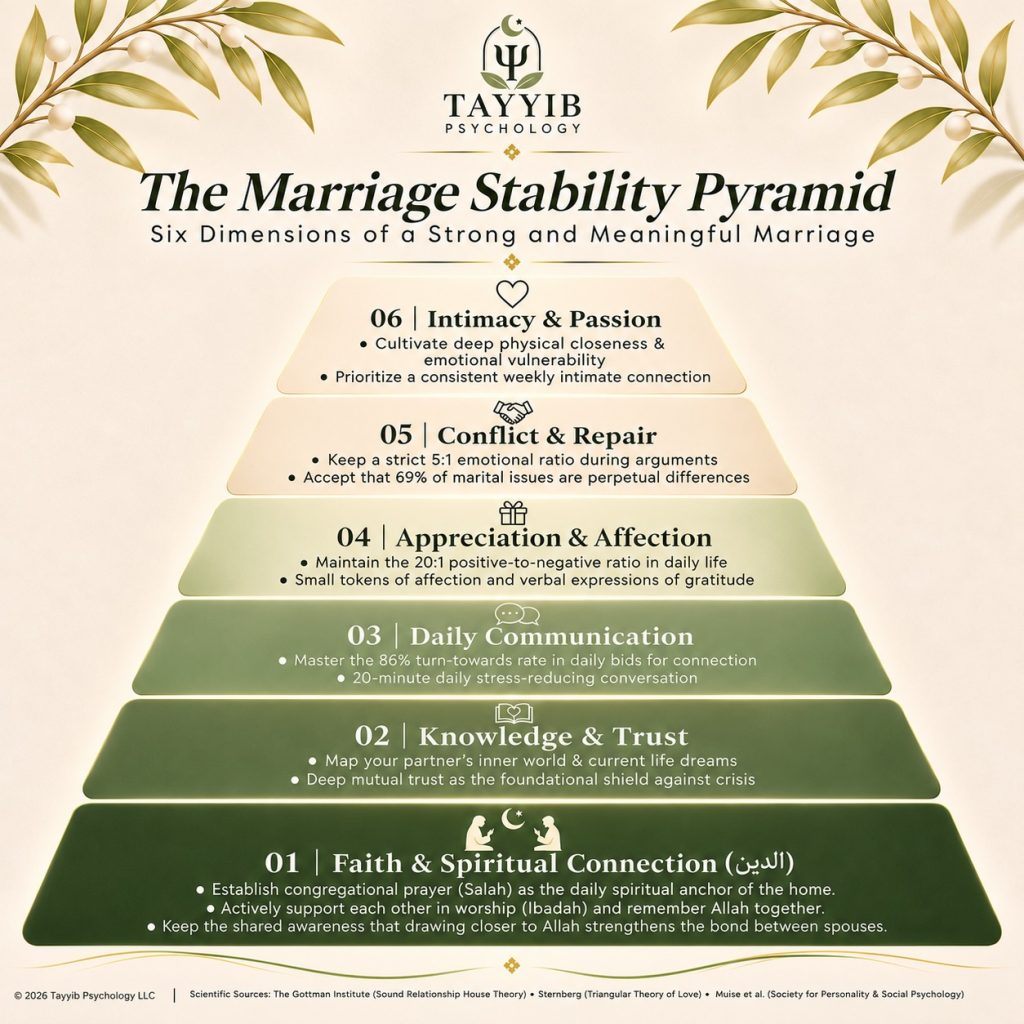
Building this sanctuary requires a structured approach. Just as a physical home needs a solid foundation before you can build the roof, a stable marriage requires a sequential pyramid of psychological layers. By understanding these levels, we can move away from cultural guesswork and begin building a secure relationship based on proven emotional pillars.
The Marriage Stability Pyramid: A visual framework combining relationship science and Islamic psychology across six developmental levels.
🔗 The Limits of Secular Advice vs. My Triadic Framework
While conventional Western relationship science—most notably the pioneering decades-long research of the Gottman Institute—offers invaluable tools for mapping couples’ behaviors, it often operates from a purely secular viewpoint. Traditional relationship counseling focuses on behavioral modification, but it leaves little room for the ultimate source of hearts aligning: the spiritual dimension. From my perspective, approaches that ignore the soul cannot fully sustain a Muslim marriage on their own, because they miss the shared spiritual purpose that unites a husband and wife.
This is exactly why my practice serves as a vital bridge between professional relationship science and timeless Islamic wisdom.
Through the Marriage Stability Pyramid within my Triadic Framework at Tayyib Psychology, the unique spiritual and psychological landscape of a Muslim marriage is placed at the absolute center of the consulting process. We do not leave your faith at the door. Instead, we combine established, evidence-based data—such as mathematical communication ratios—with profound spiritual resources like intentional gratitude and deep trust in Allah ﷻ (Tawakkul).
By integrating the mind, heart, and soul, we transform daily relational habits into acts of worship, allowing you and your partner to walk hand in hand toward an emotionally secure and spiritually meaningful life together.
🌱 The 6 Levels of the Marriage Stability Pyramid Explained
To help you evaluate and gently strengthen your relationship, let us explore the six scientific and spiritual dimensions of the pyramid, looking at how psychological action pairs with spiritual reflection:
01. The Bedrock: Faith & Spiritual Connection (الدين)
Before any psychological tool can take root, a Muslim marriage requires a shared anchor in the divine. This ultimate foundation transforms the marriage from a simple social contract into a sacred bond. By establishing regular congregational prayer (الصلاة) within the home and actively supporting each other in worship (عبادة), a couple invites divine blessing (بركة) into their lives. The shared awareness that drawing closer to Allah ﷻ inherently strengthens the bond between spouses serves as the ultimate shield against life’s inevitable storms.
02. The Foundation: Knowledge & Trust (“Love Maps”)
Building upon spiritual alignment, a marriage requires a foundation of deep partner knowledge. Relational science shows that the happiest couples continuously update their “inner map” of each other—knowing their partner’s current life dreams, quiet stressors, and personal growth goals. Spiritually, this aligns with true Amanah (أَمَانَة). It means honoring your spouse by truly seeing them as an evolving individual, creating a foundational shield of safety that protects the marriage when outer crises strike.
03. Daily Communication: The Turning-Towards Rate
In the fabric of daily life, partners constantly make small “bids for connection”—a glance, a sigh, or a casual remark. Long-term studies show that stable couples master an 86% turn-towards rate, meaning they actively respond to these small bids with attention and presence, rather than ignoring or turning away from them. This level is maintained through small, daily habits, such as a dedicated 20-minute, stress-reducing conversation after work where household logistics are left at the door and emotional presence is prioritized.
04. Appreciation & Affection: The Emotional Bank Account
A stable marriage requires an active “Positive Sentiment Override,” meaning the overall mood of the relationship is securely positive. Empirically, happy couples maintain a striking 20:1 ratio of positive-to-negative interactions in their daily, non-conflict life. This is built through consistent verbal expressions of gratitude, physical touch, and micro-gifts. In our tradition, this is the literal embodiment of Mawaddah (مَوَدَّة)—where giving a small token of affection or whispering a word of appreciation is recognized as a profound act of charity.
05. Conflict & Repair: Navigating the Inevitable
Conflict is an inevitable part of any close relationship, but stability is determined by how you navigate it. Science reveals that stable couples maintain a strict 5:1 ratio during arguments—offering five moments of de-escalation, validation, or humor for every one moment of frustration. Furthermore, psychology shows that 69% of marital issues are perpetual differences rooted in personality traits that will never fully change. True stability arrives when a couple stops trying to change the unchangeable and instead focuses on gentle repair, mutual acceptance, and practicing beautiful patience (صَبْرٌ جَمِيلٌ).
05. The Pinnacle (The Bonus): Intimacy & Passion
At the very top of the pyramid sits sexual intimacy and passion. In long-term marriages, physical closeness is not a spontaneous self-runner; it is the beautiful reward for a secure foundation. While secular media pressures couples with unrealistic expectations, empirical data shows that a consistent, mindful weekly intimate connection is the statistical sweet spot for maximum marital happiness. When levels one through four are structurally safe, physical intimacy becomes a powerful amplifier of love—a sacred space where the mind, heart, and soul completely realign.
🕊️ Conclusion: You Do Not Have to Navigate This Journey Alone
Choosing to intentionally work on the stability of your marriage is not a sign of failure—it is a brave, deeply personal step toward honoring the sacred covenant Allah ﷻ has blessed you with. Your relational challenges do not define your spiritual standing, and you never have to choose between professional consulting standards and your deeply held Islamic values.
Personal growth flourishes when science and faith walk hand in hand.
If you are ready to gently untangle heavy cultural expectations from true Islamic guidelines, and if you are longing to cultivate a more balanced mind, a peaceful heart, and a meaningful life alongside your partner, please know that you do not have to walk this path alone.
Just feel free to reach out and book a Free-15-minutes Session with me:
Model Synthesis & Conceptual Framework:
Developed by Tayyib Psychology (2026), integrating cross-disciplinary empirical data from:
- The Gottman Institute (1994): Developed by Dr. John Gottman and Dr. Julie Schwartz Gottman, establishing the Sound Relationship House Theory which validates Levels 01 to 04 (Love Maps, Turning Towards, 20:1/5:1 ratios, and Perpetual Conflicts).
- Sternberg, R. J. (1986): Formulated in the landmark paper A Triangular Theory of Love, published in the Psychological Review, which serves as the framework for Level 05 (Intimacy & Passion).
- Muise, A., et al. (2016): Published via the Society for Personality and Social Psychology (SPSP), providing the extensive multi-decade empirical evidence regarding the once-weekly optimal frequency for marital satisfaction.
When sharing or referencing the Marriage Stability Pyramid, please credit Tayyib Psychology as the author of this conceptual model.
Leave a Reply