
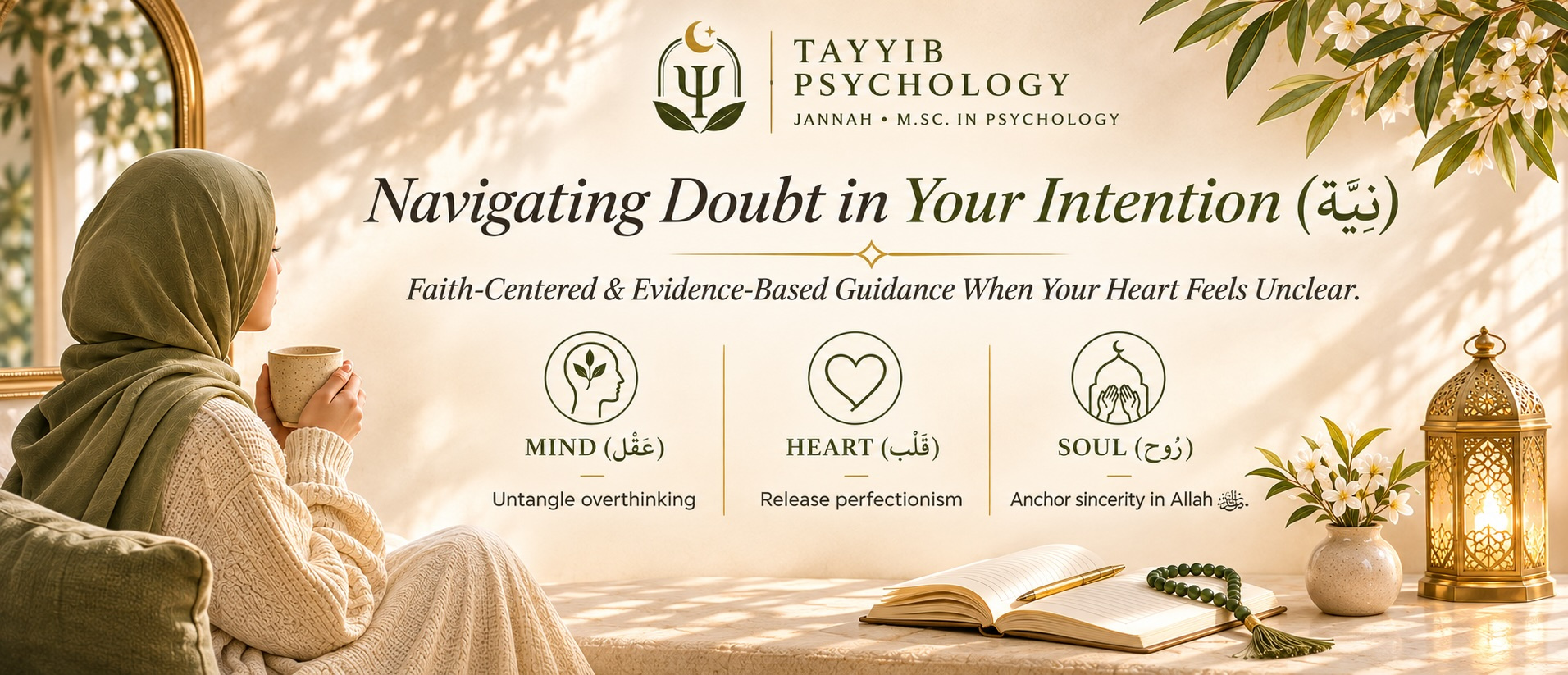
🪡 Untangling Perfectionism from Sincerity: The Silent Struggle with Niyyah (نِيَّة)
It is a quiet, exhausting inner battle that many conscientious Muslim women experience behind closed doors. You want to do good. You want to show up for your family, serve your community, wear your hijab with pride, or pursue personal growth. Yet, just as you take a step forward, a lingering whisper interrupts your peace: “Am I really doing this purely for the sake of Allah ﷻ, or am I seeking validation from people?”
When you cannot clearly read your own intention (Niyyah — نِيَّة), a heavy wave of self-doubt and paralysis often follows. You might hesitate to act at all out of fear of insincerity (رِيَاء), or feel deeply discouraged because your inner motives feel tangled and imperfect.
Perhaps you have been taught that true sincerity means never experiencing a single passing thought of ego, pride, or desire for approval. The unspoken expectation is deeply intimidating:
“If your intention isn’t 100% spotless from the very beginning, your effort is flawed.”
But here, I want to offer you a compassionate, liberating truth rooted in both Islamic tradition and psychological understanding:
“Struggling to untangle your intention is not a sign of hypocrisy—it is evidence of a living, conscious heart that deeply cares about its standing with Allah ﷻ.”
The human heart is naturally layered. Having mixed feelings or noticing a desire for human appreciation does not automatically invalidate your sincerity. Let’s explore how we can gently separate perfectionistic anxiety from true Islamic sincerity (إِخْلَاص) and guide your mind, heart, and soul back toward clarity and inner peace (سكينة).
🧶 The Root of the Paralysis: Perfectionism vs. True Sincerity
In my consulting work, I frequently observe that when Muslim women struggle to assess their Intention, the root cause is often not a lack of devotion, but a blend of cognitive overthinking and rigid perfectionism.
Classical Islamic scholars understood the fluid nature of the human heart long before modern psychology mapped out cognitive distortions. Scholars like Imam al-Ghazali emphasized that purifying one’s intention is a lifelong, dynamic process—not a static switch you flip once and never revisit. In fact, early scholars famously noted that seeking sincerity itself requires sincerity, and that noticing a flaw in your intention is the very first step toward refining it, rather than a reason to abandon good deeds.
When Shayṭān cannot stop a believer from doing good, he often shifts tactics: he convinces her that her intention is impure so that she stops acting altogether out of guilt or fear.
In reality, Allah ﷻ does not demand emotional perfection from you; He looks at your sincere effort, your struggle against your lower self (نَفْس), and your willingness to continually turn back to Him. Recognizing that your motives feel unclear is not a spiritual failure—it is an invitation to pause, reflect, and realign.
🔗 Finding Clarity Through My Triadic Framework
When you feel stuck in endless loops of self-doubt about your intentions, purely secular self-help often falls short. Conventional psychological approaches might tell you to simply “trust yourself” or “stop overthinking,” yet they miss the sacred spiritual reality of a believer who genuinely wants her actions to be accepted by Allah ﷻ.
This is why The Triadic Framework at Tayyib Psychology places you—the whole Muslim woman—at the center of our consulting process, addressing all three interconnected dimensions of your inner landscape:
- Realigning the Mind (عَقْل): Using evidence-based cognitive tools, we gently examine whether your doubt stems from genuine spiritual reflection or from overthinking, scrupulosity, and black-and-white perfectionism. When your mind learns to distinguish between a passing thought and a chosen intention, mental clarity returns.
- Restoring the Heart (قَلْب): Instead of judging yourself for wanting appreciation or feeling uncertain, we create a compassionate, non-judgmental space to process those deeper human vulnerabilities. By acknowledging your emotional needs without shame, the heart softens and lets go of defensive self-criticism.
- Anchoring the Soul (رُوح): Rather than trying to force the Inner Self into submission through harsh self-scrutiny, we anchor your soul in mindful Du’ā, remembrance of Allah ﷻ. When the mind, heart, and soul work in harmony, your ego naturally quiets down, allowing genuine sincerity to flourish organically.
🌱 Three Steps to Cultivate Clarity When Your Intention Feels Unclear
When uncertainty about your motives leaves you feeling stuck or discouraged, you can invite calm and alignment back into your heart through these three grounded steps:
🤍 1. Separate Passing Thoughts from Chosen Intentions
In psychology, we recognize that automatic thoughts and emotional urges are not choices—they are simply mental events passing through. Similarly, in Islam, fleeting whispers or a natural human desire to be appreciated do not define your Intention unless you consciously choose to center them. Acknowledge the thought without panic, release the self-judgment, and gently remind yourself why you truly wish to take this step.
🧠 2. Pause, Ground Your Mind, and Renew Your Focus
Overanalyzing your inner motives often triggers a stress response, making it even harder to feel clear-headed. Before making a decision or starting a task, take a brief moment to regulate your nervous system—take three slow, grounding breaths to step out of anxious rumination. Once your mind settles, consciously state your intention silently in your heart: “Yā Allah, I am doing this seeking Your pleasure—purify what is unclear in me.”
🤲 3. Entrust the Purity of Your Heart to Allah ﷻ
You are responsible for striving toward sincerity, not for achieving flawless inner control. True trust in Allah (تَوَكُّل) means doing your best to align your actions with what pleases Allah ﷻ, and then entrusting the rest to Al-Laṭīf (The Subtle, The Most Gentle) and Ash-Shakūr (The Most Appreciative)—the One who knows the hidden good in your heart even when you struggle to see it yourself. Make the prophetic Du’ā for protection from hidden insincerity, and then move forward with courage and peace.
🕊️ Conclusion: You Do Not Have to Navigate This Journey Alone
Feeling uncertain about your Intention does not mean your faith is weak or your efforts are wasted. On the contrary, your desire for sincerity is one of the clearest signs of a heart that deeply loves Allah ﷻ. You do not have to remain trapped in endless cycles of self-doubt or carry the weight of perfectionism alone.
When compassionate psychological insight walks hand in hand with timeless Islamic wisdom, clarity replaces confusion, and your heart finds room to breathe again.
If you are ready to gently untangle anxious overthinking from true spiritual alignment and cultivate lasting inner peace (سكينة) in your life, I warmly invite you to book a free, confidential 15-minute consultation. Together, we can walk this path toward inner clarity—one mindful step at a time.
Leave a Reply