
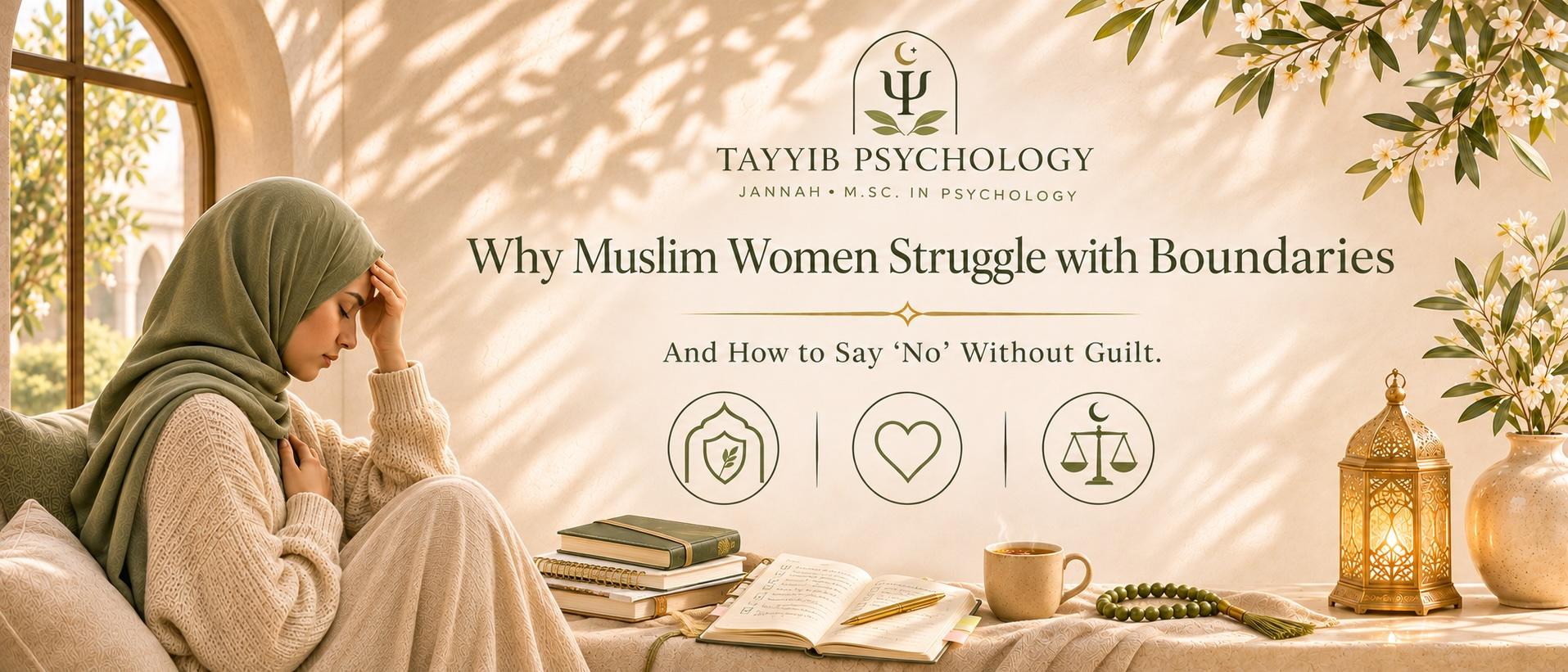
🕊️ – And How to Say “No” Without Guilt
It begins with a quiet resentment that you immediately try to pray away. You are the one who always says yes—to your family, your spouse, your in-laws, your community, and your workplace. You stretch yourself thin, managing everyone else’s emotional climate, keeping the peace at all costs, and burying your own exhaustion deeper and deeper. In those moments of drowning under the weight of everyone else’s expectations, you might feel a lingering sense of shame. You ask yourself, “Am I being ungrateful? Is my lack of joy a sign that I am failing as a Muslim woman?”
Yet, when you try to step back or gently say no, a secondary and often heavier burden creeps in: religious guilt.
Perhaps you have grown up with the cultural narrative that a good Muslim woman is one who completely erases her own needs for the sake of others. You might hear reminders about the rewards of self-sacrifice, the virtue of being easy-going, or the absolute obligation of Sabr (صَبْر). The underlying, unspoken message becomes twisted in your mind:
“If you set boundaries or prioritize your own mental well-being, you are being selfish, disrespectful, or lacking in faith.”
But here is the liberating truth your soul needs to hear today:
“Setting healthy boundaries is not an act of selfishness; it is a spiritual and psychological necessity to preserve the life and mind Allah ﷻ has entrusted to you.”
Your energy is finite, your emotional capacity has limits, and refusing to let others exploit you does not mean you lack compassion. In fact, understanding where you end and another person begins is deeply rooted in the holistic traditions of Islamic psychology, where honoring your well-being is viewed as an essential part of protecting your Amanah (أَمَانَة).
Let’s start to dismantle the cultural misconceptions surrounding emotional self-sacrifice and explore how combining scientific, evidence-based Western psychology with timeless Islamic spirituality can empower you to reclaim your peace—your Sakinah (سكينة).
🧶 The Root of the Burden: Distinguishing Selfless Devotion from People-Pleasing
In my consulting work, I frequently observe that for many Muslim women, the chronic exhausting they experience does not come from a lack of desire to serve their loved ones, but from intense societal expectations that mistake people-pleasing for religious piety. There is a profound difference between a heart that gives willingly out of love for Allah ﷻ, and a heart that gives out of fear of rejection, conflict, or cultural shaming.
When you are told that practicing Sabr means allowing your emotional and psychological boundaries to be continuously crossed without a voice, you are experiencing a cultural distortion, not an Islamic ruling.
In reality, Islam establishes clear boundaries for human relationships to ensure justice, balance, and mutual respect. During the Islamic Golden Age, classical scholars recognized that true spiritual health cannot exist in a state of psychological oppression—even when that oppression is self-inflicted through chronic people-pleasing. Scholars like Abu Zayd al-Balkhi understood that an over-exhausted mind eventually fractures the spirit, making it harder to connect with Allah ﷻ during acts of worship.
The Prophet Muhammad ﷺ lived a life that beautifully demonstrated the balance between profound compassion and firm boundary-setting. He explicitly taught that our bodies and minds have rights over us.
Rather, Allah ﷻ specifically honors the agency and voices of women in the Quran. A profound example of this divine validation is found in Surah Al-Mujadila (58:1), where Allah ﷻ hears and responds directly to a woman who came to argue her case and voice her distress regarding her domestic situation. The very opening of this Surah highlights how beautifully Islam acknowledges a woman’s right to speak up, demand justice, and establish boundaries when her well-being is compromised.
So, saying no to demands that compromise your mental stability or emotional health is not a betrayal of your faith. It is quite the opposite: it is an act of honoring the sacred trust of your own existence. By gently untangling the heavy cultural pressures of perpetual compliance from true Islamic guidelines, we can begin to lift the unearned guilt off your shoulders and allow you to serve others from a place of abundance rather than depletion.
🔗 The Limits of Secular Consulting vs. My Triadic Framework
While conventional Western psychology offers incredibly valuable tools for boundary-setting, such as assertiveness training and identifying codependent patterns, it often struggles to address the deep inner landscape of a believing woman. By operating from a strictly secular viewpoint, traditional mental well-being support might encourage you to simply cut people off or focus solely on individual autonomy. For a Muslim woman, whose heart values kinship ties (Silat ar-Rahim) and spiritual reward, this approach can feel harsh, cold, and misaligned with her soul (روح).
This is exactly why my practice serves as a vital bridge between professional Consulting and timeless Islamic wisdom.
Through my Triadic Framework at Tayyib Psychology, you—the female Muslim client—are placed at the absolute center of the consulting process. We do not leave your faith or your relational values at the door. Instead, we combine established evidence-based tools to untangle the fears behind setting boundaries, while actively nurturing the soul with profound spiritual resources like intentionality (نِيَّة) and deep trust in Allah ﷻ (تَوَكُّل).
By integrating the mind, heart, and soul, we create a compassionate space where you can learn to say “no” to people while maintaining a beautiful, loving “yes” to Allah ﷻ. Together, we ensure your inner well-being and your faith walk hand in hand until you may reach Sakinah (سكينة) with the help from Allah ﷻ.
🌱 Three Steps to Set Boundaries Without Guilt When You Feel Overwhelmed
Learning to shift away from chronic people-pleasing does not happen overnight, but you can begin to invite tranquility and balance back into your relationships by practicing these three intentional steps rooted in both psychology and faith:
🤍 1. Identify Your Emotional Leaks and Release the Guilt
The first step toward relief is paying attention to where your energy is being drained. Notice when a request from someone leaves you feeling heavy, anxious, or resentful rather than fulfilled. Acknowledge that experiencing exhaustion is a biological and psychological signal from Allah ﷻ that your system needs a break—not a reflection of a flawed spiritual state. When you stop judging yourself for having limits, you lift a heavy layer of unearned guilt off your shoulders.
🧠 2. Use the “Pause and Reflect” Technique
True well-being requires breaking automatic patterns. When someone asks you for something that instantly makes your chest tighten, ground your body first before responding. Practice a brief cognitive pause: instead of an immediate “yes,” use a gentle boundary phrase like, “Let me check my schedule and get back to you.”During that pause, calm your nervous system with a slow, deep breath, and ask your heart: “Am I doing this for the sake of Allah, or am I doing this out of fear of what they will think?” This simple practice shifts your action from an anxious reaction to an intentional choice.
🤲 3. Align Your Boundaries with the Sunnah of Balance
Setting boundaries does not mean becoming unkind or distant. It means defining what you can give without losing yourself. True Sabr is an active, dignified choice to endure trials with a clear heart, not a passive submission to burnout. Reframe your boundaries as an act of devotion: by preserving your mental health today, you are protecting your capacity to fulfill your true religious and familial duties tomorrow with a joyful, present heart.
🕊️ Conclusion: You Do Not Have to Navigate This Journey Alone
Choosing to prioritize your inner well-being and set healthy boundaries is not a sign of weak faith—it is a brave, deeply personal step toward honoring the life and mind Allah ﷻ has blessed you with. Your emotional distress does not define your spiritual standing, and you never have to choose between professional consulting standards and your deeply held Islamic values.
Personal growth flourishes when science and faith walk hand in hand.
If you are ready to gently untangle the heavy cultural expectations from true Islamic guidelines, and if you are longing to cultivate a more balanced mind, a peaceful heart, and a meaningful path toward Sakinah, I am here to guide you. Reach out today to explore how online consulting can support your journey toward true psychological and spiritual freedom.
Leave a Reply