
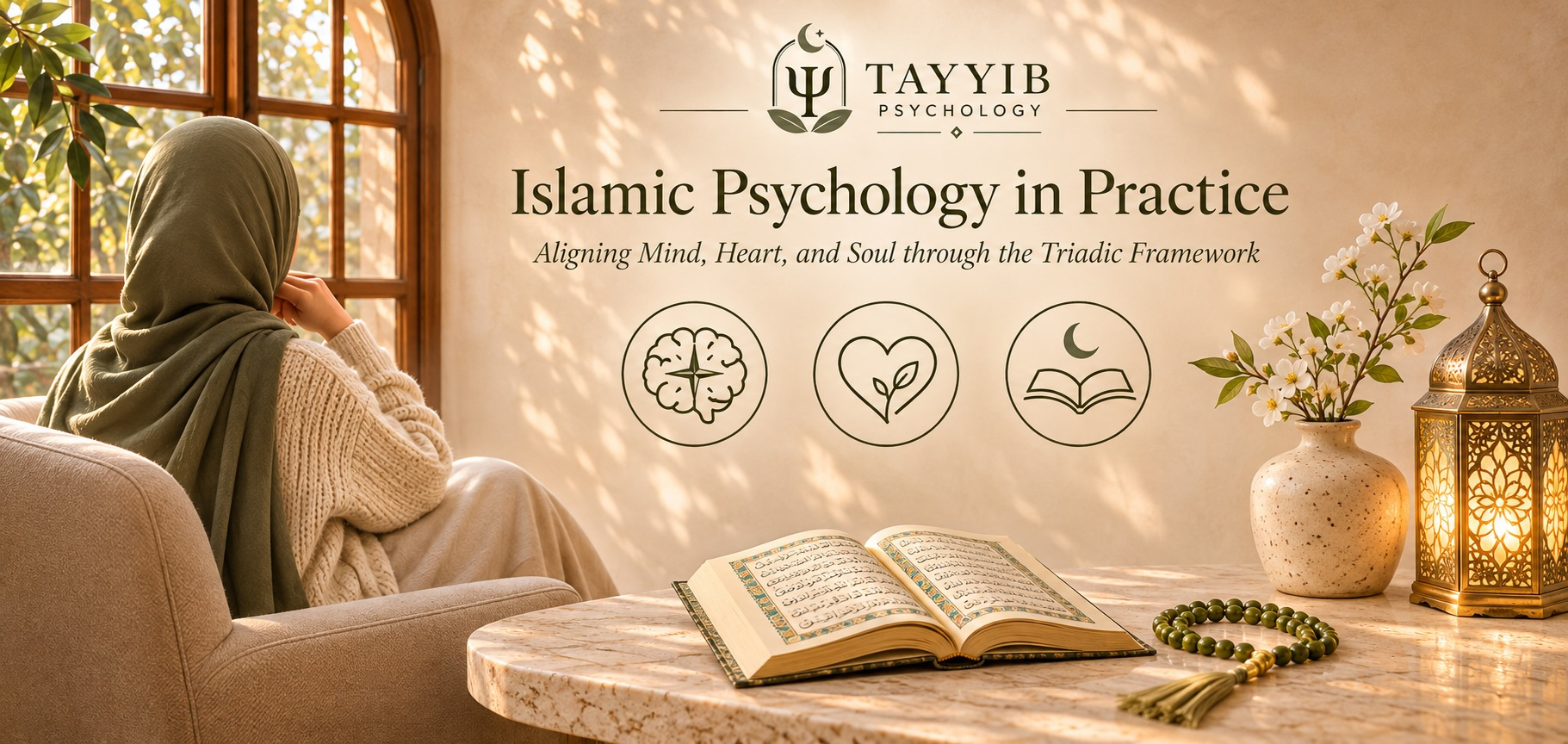
🧭 Caught Between Two Worlds: When You Feel You Must Choose Between Science and Faith
Have you ever sat in a space seeking emotional support, only to feel that you had to leave the most sacred part of your identity at the door?
For many modern Muslims, seeking guidance feels like walking a quiet tightrope. On one side, conventional secular approaches often offer helpful cognitive strategies, yet they treat your faith as a private side-note—or worse, subtly view your religious values as obstacles to personal freedom. On the other side, well-meaning advice within our communities sometimes reduces deep emotional exhaustion to a simple lack of patience (Sabr) or weak Iman.
As we explored in our reflection on Why Mental Health Struggles Aren’t a Sign of Weak Iman, emotional pain is not a spiritual failure; it is simply a reflection of your resonant humanity.
To truly move forward, you do not need to choose between sound psychological science and your relationship with Allah ﷻ. You need a structured path that honors both. This is the essence of Islamic Psychology (ʿIlm an-Nafs – عِلْم النَّفْس)—and it is the exact foundation upon which The Triadic Framework was built.
🧩 Why One-Dimensional Advice Falls Short
Human beings are not fragmented machines. You cannot separate your anxious thoughts from the unspoken grief in your heart, nor can you disconnect your emotional resilience from your soul’s longing for its Creator.
When support focuses on only one dimension, relief remains temporary:
- Purely Cognitive Strategies: Focusing solely on behavioral habits may help you organize your daily routine, yet leave you feeling spiritually hollow when facing deeper existential questions.
- Purely Spiritual Reminders: Offering theological reminders without practical emotional processing can unintentionally lead to spiritual burnout, making you feel guilty for struggling in the first place.
Classical Muslim polymaths like Abu Zayd al-Balkhi and Imam Al-Ghazali understood centuries ago that lasting inner tranquility (Sakinah – سَكِينَة) requires caring for the whole self. At Tayyib Psychology, we translate this timeless heritage into a structured, practical consulting path designed for the realities of modern life.
📐 The Triadic Framework in Action: Aligning Mind, Heart, and Soul
Rather than treating isolated symptoms in a vacuum, The Triadic Framework nurtures three interconnected pillars of your inner world. When these three dimensions are brought into harmony, clarity and resilience naturally follow.
🧠 1. The Mind (ʿAql – عَقْل): Cognitive Realignment
Your Mind serves as the rational navigation system of your daily experience. In our consulting work, we integrate evidence-based psychological tools to soften the relentless noise of overthinking and address unhelpful cognitive distortions. By building structured emotional regulation and proactive self-care routines, you regain mental clarity and focus—for instance, learning how to separate clinical thought loops from spiritual whispers, a distinction we examine closely in our guide on Waswas or Intrusive Thoughts.
❤️ 2. The Heart (Qalb – قَلْب): Emotional Restoration & Cultural Untangling
Your Heart is the central seat of deep feeling, vulnerability, and attachment. Often, Muslims carry heavy emotional exhaustion not from Islam itself, but from oppressive cultural expectations and generational guilt. In this pillar, we gently untangle cultural conditioning from the liberating mercy of your faith—creating a secure space to process grief and master the art of setting healthy boundaries, as explored in Sabr Is Not Silence and It All Starts with the Man.
🕌 3. The Soul (Ruh – رُوح): Spiritual Anchoring
Your Soul is your transcendent essence that naturally longs for proximity to Allah ﷻ. Grounded in traditional Islamic principles, this pillar provides steady theological security and sustainable spiritual habits. Rather than letting religious practice become another source of perfectionism, we anchor your daily life in reassuring clarity—helping you navigate spiritual uncertainty, much like in Navigating Doubt in Your Intention (Niyyah), so your growth becomes an act of quiet worship.
💎 The Dynamics of the Nafs: Why Healing Happens Organically
A deliberate design of The Triadic Framework is that the Nafs (نَفْس – the ego and lower desires) is not placed as one of the three main pillars.
In many rigid approaches, people are told to forcefully suppress or battle their Nafs through sheer willpower and harsh self-criticism. Yet both modern psychology and prophetic wisdom show that harsh suppression only deepens inner exhaustion.
Instead, the Nafs matures organically when its surrounding environment is aligned. As you cultivate cognitive clarity in the Mind, release cultural burdens in the Heart, and establish spiritual security in the Soul, your Nafsnaturally steps out of survival mode. It evolves steadily through its classical stages—from inner unrest (An-Nafs al-Ammarah), to self-reflective awareness (An-Nafs al-Lawwama), and ultimately toward tranquil alignment (An-Nafs al-Mutma’inna).
⚖️ Conventional Consulting vs. The Triadic Approach
To see how this integration shifts the consulting experience, consider the core differences:
- View of the Self: Conventional models focus primarily on cognition and behavioral habits; The Triadic Framework integrates Mind, Heart, and Soul as one unified whole.
- Role of Faith: Faith is often treated as a private side-note in secular settings, whereas it is honored here as the foundational source of resilience and Sakinah.
- Cultural Guilt: Standard approaches can unintentionally clash with family loyalty and religious duties, while our method clearly separates cultural pressure from authentic Islamic mercy.
- Goal of Growth: Rather than focusing solely on symptom management, our work aims for holistic inner alignment and the organic elevation of the Nafs.
🌱 Common Questions About Faith-Aligned Consulting
Not at all. Seeking structured support is a proactive form of stewardship (Amānah) over the mind and heart Allah ﷻ entrusted to you. Even the Prophets experienced profound sorrow and sought clarity through reflection and action.
An Imam provides essential religious rulings (Fatwa) and spiritual counsel. At Tayyib Psychology, we bridge traditional Islamic principles with structured, evidence-based psychological tools—giving you practical strategies for emotional regulation, boundaries, and daily resilience without neglecting your faith.
If you feel caught between overwhelming thoughts, heavy cultural expectations, and a longing for non-judgmental, faith-aligned grounding, this framework was designed specifically for your journey.
🕊️ Conclusion: Wholeness Is Your Birthright as a Believer
You were never meant to fragment yourself in order to heal. True growth happens when your rational mind is calm, your heart is free from misplaced guilt, and your soul is anchored in the mercy of Allah ﷻ.
If you are ready to step out of emotional exhaustion and explore how The Triadic Framework can support your personal path, you do not have to navigate that shift alone. At Tayyib Psychology, we offer a confidential, faith-centered consulting space tailored to your unique reality. You can book a Free Session to connect with me directly, or explore our Services & Fees to learn more about how we work together.
Leave a Reply